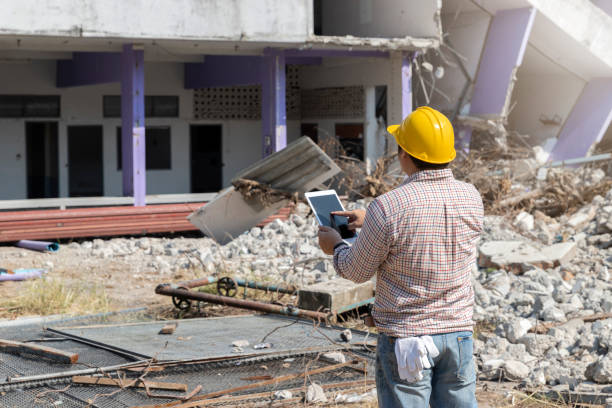
Earthquake and Structural Engineering in Turkey
In recent years, many countries around the world, including Turkey, have placed significant emphasis on proper planning for various engineering and construction projects, as well as designing structures that can withstand earthquakes in particular and natural disasters in general. As a result, greater attention has been given to studying specializations such as earthquake engineering and geomatics at universities.
Earthquake engineering specializes in structural design and analysis to construct earthquake-resistant structures and reduce seismic damage to various facilities. Geomatics engineering, also known as digital surveying technology or electronic surveying technology, specializes in collecting, analyzing, interpreting, and using geographic information through satellites, computers, and other means. Modern technologies help students in this field develop sound strategic plans for implementing various engineering projects, determining road routes and well locations, improving conditions at construction sites, and maintaining vital facilities.
Discover more information about studying earthquake engineering and geomatics in Turkey in this article with Hallak EDU.
Overview of Earthquake Engineering in Turkey
Earthquake engineering is considered one of the most important specializations in Turkey. It aims to study the design, construction, and maintenance of building structures exposed to earthquakes and reduce the damage caused by earthquakes to facilities.
Earthquake engineering is taught in architecture and civil engineering faculties in Turkey, usually through master’s and doctoral programs.
Turkish universities place special emphasis on earthquake engineering and provide modern curricula, technologies, and laboratories for studying this field.
With Hallak EDU, enjoy expert guidance and comprehensive support throughout your academic journey.
Benefits of Studying Earthquake Engineering in Turkey
Turkish universities specializing in earthquake engineering train students to design, construct, and maintain structural systems capable of withstanding seismic stresses using modern curricula.
Turkish universities have strong teaching staff with extensive experience and expertise in earthquake engineering.
Turkish universities have research centers, laboratories, and observatories dedicated to earthquake engineering, such as the Kandilli Observatory and Earthquake Research Institute at Boğaziçi University. Turkish university students participate in international conferences to exchange ideas, expertise, and projects in earthquake engineering, in addition to university partnerships in research and scientific studies with leading universities around the world.
Contact us today to find the answers and guidance that will help you achieve your academic dreams.
Universities Offering Earthquake Engineering in Turkey
- 1. Boğaziçi University (Boğaziçi Üniversitesi)
Boğaziçi University is one of Turkey’s leading universities and is home to the Kandilli Observatory and Earthquake Research Institute. It is a multidisciplinary earthquake research organization that offers graduate programs in earthquake engineering, geophysics, and geodesy.
The university has a Department of Earthquake Engineering, which began operations in 1989 as an academic department within the Kandilli Observatory and Earthquake Research Institute. It was the first academic unit in Turkey to offer master’s and doctoral graduate programs in earthquake engineering.
The earthquake engineering program is designed for civil engineers who wish to specialize in this field.
The goal of the university’s earthquake engineering department is to train engineers capable of contributing to the mitigation of the social, material, and economic losses caused by earthquakes by helping develop and construct earthquake-resistant structures, systems, and cities.
The Department of Earthquake Engineering at Boğaziçi University has played a leading role in promoting earthquake risk reduction in Turkey through participation in various national committees and nationally funded projects.
The department maintains close relationships with international organizations, universities, research centers, and government institutions around the world.
Students in the department complete a two-year master’s degree with a thesis, while the doctoral program also takes two years, provided that the master’s degree is completed first.
- Middle East Technical University (Orta Doğu Teknik Üniversitesi)
It is a public technical university in Turkey located in the capital city of Ankara. It is considered one of the leading universities in scientific and technological research in Turkey and the Middle East and is a member of the European University Association.
The educational and research programs at Middle East Technical University focus on engineering and natural sciences.
The earthquake engineering course is taught in English as part of the master’s program at the Faculty of Architecture.
The university’s earthquake studies program is an interdisciplinary master’s program covering the following fields:
Earthquake engineering,
Tectonic activity,
Disaster management
- Maltepe University (Maltepe Üniversitesi)
Maltepe University is one of the top 3,000 universities in the world and ranks 100th nationally in Turkey. Students study earthquake engineering in a two-year master’s program with or without a thesis.
The program is designed for students who hold a bachelor’s degree in civil engineering or a related field.
This program is designed for graduate students who have the ability to develop creative solutions to local, national, and global problems in earthquake engineering and design engineering structures capable of withstanding the effects of earthquakes while causing minimal damage.
- Istanbul Aydın University (Aydin Üniversitesi)
It is one of Turkey’s leading universities and is located in Izmir. It is among the country’s major universities. Established in 1955, it has grown into an important center for education and research across various disciplines.
For earthquake and structural engineering, this specialization can be found within engineering faculties at Ege University. Academic programs cover earthquake engineering and civil engineering in general, aiming to train students to understand, design, and construct earthquake-resistant structures and systems.
Courses in this specialization typically include a range of subjects such as:
- Seismology and earthquake analysis.
- Design and construction of earthquake-resistant buildings.
- Seismic hazard assessment and analysis.
- Design of earthquake-resistant foundations.
- Using modern technology in the analysis and design of seismic structures.
These educational programs aim to provide students with the knowledge and skills necessary to contribute to the design and construction of earthquake-resistant infrastructure and improve communities’ preparedness and response to this destructive natural phenomenon.
Hallak EDU, where precision meets dedication throughout your educational journey.
About Geomatics Engineering in Turkey
- The main geomatics engineering programs in Turkey aim to train engineers to acquire knowledge and skills related to the concepts, principles, and methods of geographic information systems, surveying and photogrammetry, geodesy, cartography, measurement, and remote sensing technology.
- Turkish universities offering geomatics programs have modern laboratories, research facilities, and centers in this field, such as the Geomatics Research and Application Center (GEOMER) at Istanbul Kültür University.
Benefits of Studying Geomatics Engineering in Turkey
- Universities offering geomatics engineering recognize and value scientific professionals and researchers in the field, helping educate and train students according to modern curricula.
- Universities offering geography-related programs encourage students to participate in activities that improve their academic and professional skills and knowledge in accordance with academic curricula.
- Students complete real-world design and application projects to ensure their professional success, and work environments are created where they can gain experience solving problems they may encounter in their field.
- The cost of studying geomatics in Turkey is lower compared with studying in Europe or the United States.
Rest assured that you can achieve your academic goals with our effective and professional support at Hallak EDU.
Cost of Studying Geomatics in Turkey
The cost of studying geomatics in Turkey is relatively low compared with other countries.
The cost of a thesis-based master’s degree in geomatics engineering at Istanbul Kültür University is $4,500.
The cost of a non-thesis master’s degree in geomatics engineering at Istanbul Kültür University is $3,500.
The cost of a thesis-based master’s degree in geomatics engineering at Istanbul Okan University is $5,400.
The cost of a non-thesis master’s degree in geomatics engineering at Istanbul Okan University is $5,400.
What are the requirements for studying earthquake engineering and geomatics at Turkish universities?
Universities require a bachelor’s degree in civil engineering or a related field for admission to a master’s degree, and a bachelor’s and master’s degree in civil engineering or a related field for admission to a doctoral program.
In addition, students must demonstrate proficiency in the language of instruction, whether Turkish or English.
Records and Documents Required to Study Earthquake Engineering and Geomatics at Turkish Universities:
A recent personal photograph of the student.
A copy of the passport translated into Turkish or English.
A high school diploma translated into Turkish or English and certified.
A transcript translated into Turkish or English and certified.
An English language certificate, such as IELTS or TOEFL, if available.
Support and Preparation Programs We Offer at Hallak EDU
TOEFL Program:
We offer intensive and effective courses to prepare students to take the TOEFL exam, helping them improve their English language skills and ensuring success on the test.
IELTS Program:
We offer training courses to prepare students for the IELTS exam, with a particular focus on developing the four English language skills: listening, reading, writing, and speaking.
SAT Program:
We offer specialized courses to prepare students to take the SAT, focusing on key subjects and test-taking strategies.
TR-YÖS Program:
The TR-YÖS is a local exam that is not internationally recognized and is administered by most Turkish universities. It stands for “Yabancı Uyruklu Öğrenci Sınavı,” which translates to “Foreign Student Examination” in Turkish. The YÖS exam is a key admission requirement for Turkish public universities.
Students’ scores on the YÖS exam play an important role in improving their overall scores and contribute to their chances of admission to highly competitive faculties such as Medicine and Pharmacy. In general, the YÖS exam consists of several sections:
Mathematics questions.
Logic and intelligence questions.
Geometry topics.
Turkish and English Language Proficiency Exam Program:
We offer intensive programs to assess students’ proficiency in both Turkish and English, ensuring significant progress in their language level.
Interactive ICDL Mathematics Program:
We offer interactive courses to strengthen students’ mathematics skills, helping them prepare effectively for their academic studies.
With Hallak EDU, we are committed to providing specialized programs that contribute to students’ success in their exams and prepare them for their studies with confidence.