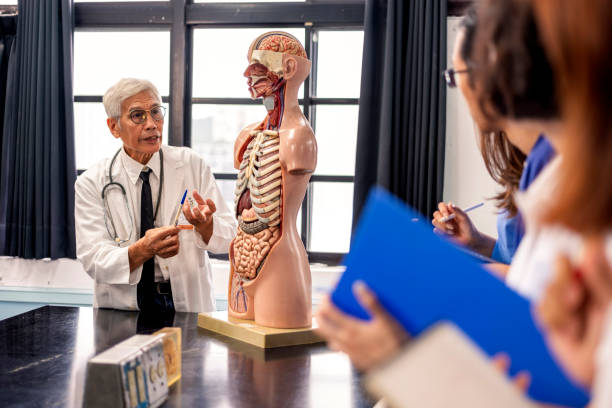
Studying Anatomy in Turkey
Medical fields attract an increasing number of students every year, and one of the most prominent fields within the health sciences is anatomy, which is primarily associated with the fields of medicine and biology and is divided into three main branches: human anatomy, animal anatomy, and plant anatomy.
While studying anatomy in Turkey, students explore the two main types of anatomy: gross anatomy and microscopic anatomy. They gain further experience in each type. Gross anatomy aims to introduce students to all information related to organs and biological structures, while microscopic anatomy focuses on studying human cells and very small tissues that cannot be seen with the naked eye, as well as those of animals and plants.
In addition to master’s degree programs, Anatomy is also available as a PhD program at Near East University in Northern Cyprus.
Communicating with the Hallak EDU team ensures that you receive all the information you need accurately and quickly.
Key Courses in Anatomy
There are several core and specialized courses that students study when choosing this field in an academic program in order to master it. The specialized anatomy courses include:
Histology
Biology
Pathology
Laboratory Analysis
Clinical Anatomy
Advanced Biochemistry
Pharmacology
Advanced Anatomy and Cell Biology
Embryology
Neuroanatomy
Advanced Human Physiology
Embalming and Its Techniques
Microtechniques
Experimental Design and Biostatistics
Welcome to your educational future. Study in Turkey for Iraqi students with Hallak EDU.
Hallak EDU and study in Turkey requirements. Start your educational journey today.
Duration of Anatomy Studies in Turkey
Anatomy studies in Turkey typically take 4 years, which may increase to 5 years if the student attends a preparatory year at the beginning to learn and master the language. During the program, students combine the scientific aspect represented by the courses mentioned above with the theoretical and practical aspects through laboratory research and hands-on training.
Advantages of Studying Anatomy in Turkey
Turkey’s strong focus on medical fields and its provision of numerous laboratories for student training help strengthen practical skills and provide students with early hands-on exposure before professional practice.
Turkey relies on modern, internationally recognized curricula for teaching anatomy that comply with university education standards.
Turkish universities provide students with the latest scientific technologies and modern technological tools that facilitate the learning process.
Tuition fees at Turkish private universities are reasonable and affordable for many students.
Studies are conducted under the supervision of professors and experts in anatomy, allowing students to gain numerous skills and experiences.
Career Opportunities for Anatomy Graduates
Every student looks forward to a highly promising career future and therefore strives to choose an academic field that is in increasing demand in the job market and is not likely to become stagnant. Among medical fields, anatomy is one of the fundamental disciplines that remains essential and is required across many sectors, including:
Anatomy and histology laboratories
Forensic medicine laboratories
Hospitals as anatomy specialists
Radiology and medical imaging centers
Medical laboratories
Forensic laboratories
Our team gives you the opportunity to communicate directly, ask your questions, understand your needs, and receive appropriate guidance for the next steps in your educational journey.
Do not hesitate to contact the Hallak EDU team today to receive the support you need to achieve your educational goals and build your academic future.
Studying Anatomy and Histology in Turkey
Microscopic anatomy is also known as histology. Many changes and developments have taken place in the methods used to teach the field of “Anatomy and Histology,” also known in English as “Anatomy and Histology.”
Personal Characteristics of Anatomy and Histology Students
Each of us has a unique personality and characteristics that distinguish us from others. This makes certain university fields suitable for some people but not the right choice for others. Therefore, always make sure to choose a field that is fully compatible with your academic qualifications, personal interests, and aspirations.
Perhaps the most important characteristic that students in this field should have is a love of medical sciences and a desire to pursue one of the medical disciplines.
The most important academic qualifications and personal abilities for students in this field include:
Academic Qualifications:
- Academic excellence and a high high school GPA
- Only students who graduated from scientific, health sciences, or nursing tracks in high school are eligible to enroll in this field
Personal Skills and Abilities:
- Courage
- Self-control
- Ability to avoid feeling disgusted
- Self-awareness
- Strong observation and analytical skills
- Ability to handle difficult situations
- Integrity and honesty at work
- Good level of English
- Ability to use information to make decisions
- Writing skills, as the field requires writing and preparing reports
- Accurate assessment skills to properly evaluate medical conditions
- Highly precise skills for providing high-quality samples for microscopic examination
- Readiness to study one of the applied medical specialties
- Very strong communication skills, due to the need to communicate with all cases
- Excellent memorization skills, as the field relies heavily on a good memory
- Examination and interpretation skills, as the field requires examining cells and tissues and interpreting what is observed
Please note that anatomy and histology may not be suitable for you if you are nervous, impatient, quick-tempered, have a phobia of blood, cannot tolerate difficult situations, are easily affected by human cases, feel disgusted by certain scenes, or do not have a good background in scientific subjects.
Anatomy and Histology Specializations
Anatomy is naturally divided into two main branches: gross anatomy and microscopic anatomy. First, gross anatomy aims to collect information about structures and organs and study biological structures that can be seen with the naked eye.
Microscopic anatomy, also known as “Histology,” studies the cells and tissues of humans, animals, and plants. These cells and tissues are extremely small and cannot be seen with the naked eye.
Anatomy and histology are also used for educational purposes, diagnosis, forensic investigations, and autopsies.
Anatomy and Histology Courses
Study Plan
In most cases, this field is more commonly available as a graduate-level program than as an undergraduate program in many Arab countries, meaning that it is offered at the master’s and doctoral levels more often than at the bachelor’s level.
Therefore, the study plan for a bachelor’s degree differs from that of a master’s degree, and the courses and subjects taught vary depending on the country and university where the field is offered. Some examples of the most important courses in this field include:
Advanced Anatomy and Cell Biology – Advanced Anatomy and Cell Biology
- Embryology – Embryology
- Histology – Histology
- Neuroanatomy – Neuroanatomy
- Embalming and Plastination – Embalming and Plastination
- Advanced Human Physiology – Advanced Human Physiology
- Clinical Anatomy – Clinical Anatomy
- Microtechniques – Microtechniques
- Electron Microscopy – Electron Microscopy
- Modern Anatomical and Histological Techniques – Modern Anatomical Histological Techniques
- Advanced Biochemistry – Advanced Biochemistry
- Experimental Design and Biostatistics – Experimental Design and Biostatistics
- Advanced Pharmacology – Advanced Pharmacology
Duration of Anatomy and Histology Studies
A bachelor’s degree requires four years of study, like most other fields within the sciences, social sciences, and humanities. Students may complete the required credit hours and academic requirements in less than four years, potentially graduating in three to three and a half years depending on the number of credits and semesters they complete each term. Other fields may take more than four years, such as engineering programs, which may require at least five years, and medical programs, which can extend to seven years. A master’s degree in most fields generally takes one and a half to two years.
Demand and Saturation Rate for Anatomy and Histology
Future of Anatomy and Histology
Medicine and its various fields, including radiology, anesthesiology, psychiatry, veterinary medicine, dentistry, and anatomy, complement one another, and demand for these fields cannot cease in different parts of the world.
This is because all medical disciplines depend on one another. For example, when a patient undergoes surgery, the anesthesiologist monitors and evaluates the patient’s health and develops an anesthesia plan based on their findings, while anatomical examination may be performed at the macroscopic or microscopic level to identify the medical condition. The specialist physician and assistants then perform the surgery, after which the nurse carries out their duties of monitoring and caring for the patient during their hospital stay. Medical professionals cannot function independently of one another, which makes medical fields in demand around the world.
Despite this, some countries may have stagnant or saturated job markets for this field. So, what is the difference between a field being in demand and being stagnant or saturated?
A field is considered in demand when the job market needs its graduates, making it easier for graduates to find job opportunities. A field is considered stagnant or saturated when graduates have difficulty finding employment because the country’s labor market does not require more professionals in that field.
Advantages and Disadvantages of Anatomy and Histology
The main advantages and disadvantages associated with studying anatomy and histology include:
Advantages:
- Achieving a prestigious position in society after graduation
- The field is application-oriented, and practical application is always one of the most enjoyable and effective educational methods
- Technology has created a virtual environment through which students can view cadavers and anatomical structures in three dimensions. This has led to what is known as 3D anatomy
Disadvantages:
- The cost of the program may be high
- The field is somewhat difficult and complex
- Some studies may require work with cadavers, which can be frightening for some people
- Career Fields for Anatomy and Histology Graduates
Graduates of histology programs may work as:
- Histology Technician – Histology Technician
- Doctor – Doctor
- Biologist – Biologist
- Medical Laboratory Technician – Medical Laboratory Technician
All of the above may work in anatomy and histology laboratories, including forensic medicine laboratories.
Anatomy and histology professionals use various techniques such as medical imaging, X-rays, and ultrasound. They also use various medical imaging technologies such as magnetic resonance imaging.
The main purposes and objectives that professionals working in anatomy and histology can address include:
- Crime analysis
- Determining causes of death
- Academic and educational purposes.
Support and Preparation Programs We Offer at Hallak EDU:
TOEFL Program:
We offer intensive and effective courses to prepare students to take the TOEFL exam, helping them improve their English language skills and ensuring success on the test.
IELTS Program:
We offer training courses to prepare students for the IELTS exam, with a particular focus on developing the four English language skills: listening, reading, writing, and speaking.
SAT Program:
We offer specialized courses to prepare students to take the SAT, focusing on key subjects and test-taking strategies.
TR-YÖS Program:
The TR-YÖS is a local exam that is not internationally recognized and is administered by most Turkish universities. It stands for “Yabancı Uyruklu Öğrenci Sınavı,” which translates to “Foreign Student Examination” in Turkish. The YÖS exam is a key admission requirement for Turkish public universities.
Students’ scores on the YÖS exam play an important role in improving their overall scores and contribute to their chances of admission to highly competitive faculties such as medicine and pharmacy. In general, the YÖS exam consists of several sections:
Mathematics questions.
Logic and intelligence questions.
Geometry topics.
Turkish and English Language Proficiency Exam Program:
We offer intensive programs to assess students’ proficiency in both Turkish and English, ensuring significant progress in their language level.
Interactive ICDL Mathematics Program:
We offer interactive courses to strengthen students’ mathematics skills, helping them prepare effectively for their academic studies.
With Hallak EDU, we are committed to providing specialized programs that contribute to students’ success in their exams and prepare them for their studies with confidence.