


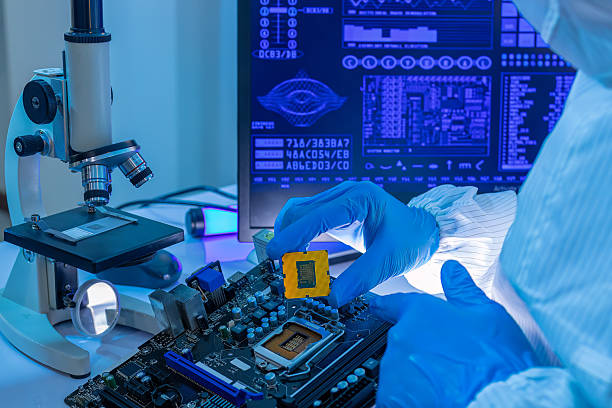
Electronic Chip Design in Turkey
Overview of Software Engineering
Engineering programs are among the most popular study programs for students wishing to study in Turkey, due to the development of engineering programs at Turkish universities. Many Turkish universities offer advanced Computer Engineering and Software Engineering programs and are distinguished by providing the necessary equipment and facilities to enable students to practice and apply what they learn through advanced engineering laboratories and facilities. In addition, they provide students with practical and professional training opportunities within companies and factories. Many Turkish private universities also offer Computer Engineering and Software Engineering programs in English at affordable costs.
The bachelor’s degree in both fields takes 4 years of study in Turkey. The duration may increase by one additional year if the student enrolls in a language preparatory school, and by two years to obtain a master’s degree.
Contacting the Hallak EDU team ensures that you receive all the information you need accurately and in a short time.
Electronic Chip Design
Turkey is one of the few countries in the world capable of manufacturing electronic chips using domestic capabilities. Since 1983, the YİTAL laboratory, established to conduct research in semiconductor technology, has produced chips for national products, particularly defense products.
As the global chip crisis that affected the technology and electronics markets continued, Turkey recognized the importance of the plans it had developed decades earlier to achieve independence in this industry. This encouraged the country to increase investments in the field and urged prestigious universities and private companies to cooperate in designing and producing the chips needed for its national vehicles and domestic defense industries.
Alongside government efforts to localize these sensitive industries, Turkish companies operating in the electronic chip manufacturing sector are seeking to benefit from the growing demand for these products as technology advances and its use increases, accompanied by the growth of the consumer electronics market.
While the automotive industry was one of the sectors most affected by the chip crisis that erupted with the beginning of the COVID-19 pandemic more than two years ago, Turkey, which ranks fourth in automotive production and exports in Europe, is seeking to secure an advanced position among the few countries capable of designing and manufacturing chips.
Hallak EDU and the requirements for studying in Turkey for Jordanians — Start your educational journey today.
Requirements for studying in Turkey for Syrians with Hallak EDU — Opportunities are available for Syrian students.
Libya to Turkey — Hallak EDU provides the requirements for studying in Turkey for Libyan students to help you achieve your educational ambitions.
Local Chips for the National Car
The automotive market is one of the sectors most affected by the chip crisis. According to the American consulting firm AlixPartners, the total damage to the automotive industry reached $110 billion by the end of 2021. According to figures announced by the Uludağ Automotive Industry Exporters Association in the Turkish city of Bursa, the Turkish automotive industry, which ended 2021 with exports worth $19 billion, an increase of 15% compared to the previous year, ranked 15th globally and fourth in Europe.
As problems with chip production and supply increased in markets dominated by companies from South Korea, Taiwan, and the United States, automotive and electronics manufacturers turned to alternative supply chains. While Turkey plans to have a domestic car by the centenary of the founding of the republic, it does not want this goal to be disrupted by the chip crisis.
For this specific reason, attention turned to TÜBİTAK BİLGEM, a provider of technological capabilities and a manufacturer of optoelectronic detectors for Turkish drones, as this center, which designs and manufactures chips and optoelectronic detectors for the defense industries, is capable of developing and manufacturing chips specifically for automobiles.
Turkey’s YİTAL Chip Manufacturing Laboratory
Turkey is one of the few countries in the world with its own chip manufacturing capabilities. Since 1983, Turkey has been producing domestic electronic chips for national products through the YİTAL laboratory, which was established under TÜBİTAK BİLGEM to conduct research in semiconductor technology. Currently, 55 engineers work around the clock on chip technology.
The YİTAL center has the infrastructure required to carry out integrated circuit (IC) design, mask production, wafer processing, chip inspection, packaging, circuit testing, and aging processes. The facility also includes 800 square meters of cleanroom space, making YİTAL the only laboratory in Turkey producing integrated circuits using semiconductor technologies.
Although chip production remains limited in Turkey, strategic semiconductor needs are given the highest priority in the development and production of domestic missiles, smart ammunition, and armed drones. In parallel with Turkey’s space ambitions, the center is also researching space-grade IC manufacturing technology.
The center also collaborates with several universities that support master’s and doctoral programs benefiting from semiconductor technology in Turkey and electronic design capabilities.
Our team allows you to interact directly with us, ask your questions, understand your needs, and receive the appropriate guidance for the next steps in your educational journey.
Do not hesitate to contact the Hallak EDU team today for support in achieving your educational goals and building your academic future.
First Commercial Chip Manufacturing Facility
In 2016, Turkish electronics and military communications systems company ASELSAN, in cooperation with Bilkent University, launched the first private commercial facility for manufacturing electronic chips. The facility produces high-tech products required by the defense, aerospace, communications, and energy sectors.
The facility, named AB Micro Nano, was established with an investment of approximately $30 million and aims to produce small and micro-scale devices, particularly III-V semiconductors and similar technological materials. The facility will produce chips that are more advanced than those Turkey purchases and that the country may sometimes be unable to obtain even when needed due to sanctions, while also opening new opportunities to export products with significant economic value.
Thanks to the gallium nitride chips that will be produced at this facility, Turkey will become one of the few countries in the world capable of producing strategic technologies such as defense radars, electronic warfare systems, power electronics, and space technologies, in addition to automotive, aviation, high-speed rail, and 5G mobile technologies.
While gallium nitride has superior properties compared with other products used in this field, the gallium nitride market is expected to grow rapidly over the next ten years, with activities in this sector expected to generate significant economic returns.
Requirements for Studying Software Engineering in Turkey
In general, admission exams are not required at Turkish private universities. Students only need to have an academic grade above 50% and provide a language proficiency certificate according to the language in which the program is offered at the university. If the student does not have a language proficiency certificate, they take a language placement or proficiency test. If they do not achieve the required score, they must attend the university’s language preparatory year.
Chips form the foundation of rapidly developing digital industries, and any country seeking to dominate the digital future needs to purchase these ultra-fast and ultra-thin chips from Taiwan or South Korea.
Best University for Software Engineering in Turkey
The best universities offering Software Engineering programs with advanced technologies and highly developed skills include:
- Altınbaş University in Istanbul.
- Istinye University.
- Istanbul Aydın University.
- Bahçeşehir University.
- Üsküdar University.
Required Documents for Studying Software Engineering and Chip Design in Turkey
High school diploma with a transcript.
Copy of passport.
Passport-size photo.
Mother’s name.
Your email address.
Software Engineering has become increasingly popular among international students in Turkey. Before applying to universities in Turkey, it is important to understand the educational content you will study in this field.
Contact the Hallak EDU team for information and support.
If you are looking for specific information about available programs and tuition fees, or if you have any additional questions, it is recommended that you contact the Hallak EDU university support team. Our team is available to provide professional and friendly assistance.
Support and Preparation Programs We Offer at Hallak EDU:
TOEFL Program:
We provide intensive and effective courses to prepare students for the TOEFL exam, helping improve their English language skills and ensuring success in the test.
IELTS Program:
We provide training courses to help students pass the IELTS exam, with a special focus on developing the four English language skills: listening, reading, writing, and speaking.
SAT Program:
We provide specialized courses to prepare students for the SAT exam, focusing on key subjects and test-taking strategies.
Tr YÖS Program:
Tr YÖS is a local examination that is not internationally recognized and is administered by many Turkish universities. It is an abbreviation for “Yabancı Uyruklu Öğrenci Sınavı,” which translates into English as “Foreign Student Examination.” The YÖS exam is a key admission requirement for Turkish public universities.
A student’s score on the YÖS exam plays an important role in improving their overall admission score and contributes to their chances of being accepted into highly competitive faculties such as Medicine and Pharmacy. In general, the YÖS exam consists of several sections:
Mathematics questions.
Logic and intelligence questions.
Geometry topics.
Turkish and English Language Proficiency Exam Program:
We provide intensive programs to assess students’ proficiency in both Turkish and English, ensuring significant progress in their language level.
Interactive ICDL Mathematics Program:
We provide interactive courses to enhance students’ mathematics skills, helping them prepare effectively for their academic studies.
At Hallak EDU, we are committed to providing specialized programs that contribute to students’ success in their exams and prepare them for their studies with confidence.